The Physics of Entrepreneurship: Why You Must Build Potential Before You Can Create Motion
You have ideas about your “next big thing.”
You can see the finish line. Also, you can visualize the sales, the happy customers, the growing team, and the success. It feels close enough to touch. But between your idea and that reality, there is a massive gap. You need to do many things to make it real. And the order in which you do them matters more than the effort you put in.
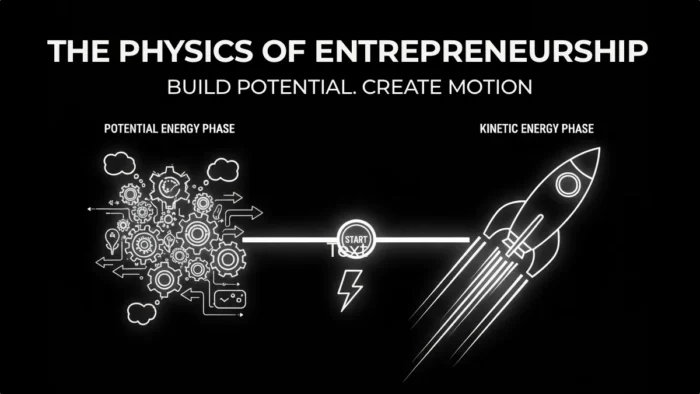
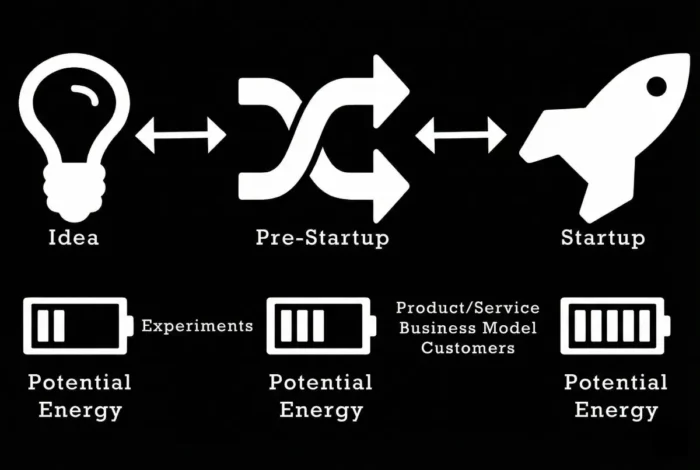
According to my experience working with entrepreneurs over the last two decades, the process of bridging this gap is not a single sprint. It isn’t a chaotic scramble to “just get started.” It is distinctively split into two stages:
- The Pre-Startup stage (The Accumulation Phase)
- The Startup stage (The Kinetic Phase)
Most prospective entrepreneurs rush straight to the second stage. They register the domain, hire the developer, rent the office, and want to start “doing.” They are addicted to the feeling of motion.
But this doesn’t seem right. In fact, skipping the first stage is exactly why they fail. They are trying to fire a cannonball from a canoe. If you want to succeed, you need to understand the physics of business. You need to understand energy.
The Concept of Business Potential Energy
If you read this site regularly, you have probably already heard me discuss the concept of Business Potential Energy. I have been developing this concept for more than 20 years, writing about it since the early days of Entrepreneurship in a Box.
Related: How You Can Measure Business Potential Energy of Your Business Ideas
Generally, this concept is based on physics.
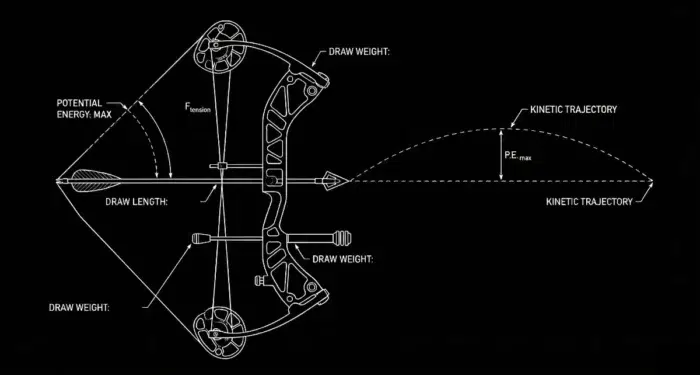
In the physical world, potential energy is the energy stored in an object due to its position or state. A drawn bowstring has potential energy. Water held back by a dam has potential energy. It is dormant power. It is “ability in waiting.”
Business Potential Energy is no different.
It is energy stored in your company, your startup, or even in something that does not yet exist as a legal entity. It is the accumulated value of your insights, your validated data, your relationships, and your business model design.
Related: 4 Steps Business Idea Generation Process in Entrepreneurship
However—and this is the critical part—this energy doesn’t give you results until it is transformed into kinetic energy.
Think of your business idea as a battery. An invalidated idea is an empty battery. It has the capacity to hold power, but currently, it holds zero charge.
The pre-startup phase is the charging station.
The mistake most people make is trying to create motion (sales, growth, scale) when they haven’t stored up enough potential energy to fuel it. They try to drive a Tesla with a AA battery. They grind, they hustle, and they burn out, wondering why the market isn’t responding.
This concept continues to evolve as I gain additional experience working with small and medium-sized companies, but the rule remains the same: You cannot create kinetic impact without potential leverage.
Look at this article for 10 Questions to Ask Yourself Before Your Next Startup
Stage 1: The Pre-Startup (The Accumulation Phase)
The first stage is the pre-startup stage. You can also think of this as the “Preparation Stage” or the “Laboratory Stage.”
In terms of physics, the pre-startup stage is what you do to increase your business’s potential energy.
This stage is arguably more important than the startup stage itself because many things in the second stage depend exactly on what you do here. The height of your success is determined by the depth of your preparation.
Give me six hours to chop down a tree and I will spend the first four sharpening the axe.Abraham Lincoln
For example, the mistakes made in this pre-startup stage will directly impact the results you achieve later.
If your foundation is weak, your building will be unstable. If you build a factory to produce a product nobody wants, you haven’t built a business; you’ve built a very expensive mistake.
What are you actually doing in the Pre-Startup stage?
You aren’t just “thinking” or “dreaming” here. This is not a passive stage. You are actively building your next big thing and, more importantly, the business model that supports it.
This business model needs to support you in delivering value—not just to anyone, but to your ideal customers.
In fact, ideal customers are the most important “product” you will produce during the pre-startup stage.
This is a concept that trips many people up. How can you produce a customer before you have a business?
You do it by engaging them, interviewing them, and securing their commitment before you build the final solution.
If you have a list of 500 people who have said, “I have this problem, and I will pay $50 for a solution,” you have successfully “manufactured” a customer base.
You have stored massive potential energy.
Think about this stage as a production process that produces three specific outputs:
- Customers: You are “creating” customers by identifying them and validating that they actually want what you have.
- Products or Services: The actual value proposition (the prototype, the offer).
- The Business Model: The engine that will deliver and monetize the value (pricing, channels, costs).

Read more about the 10 most important elements with the business potential energy.
The Art of the Pivot: Why Failure Here is Cheap
There is one constant in the pre-startup stage: Change.
You will need to change your process several times. We call these changes “pivoting.”
In the pre-startup stage, pivoting is cheap.

Let’s look at an example.
Imagine you want to start a gourmet burger delivery service.
- In the Pre-Startup stage: You realize people don’t want gourmet burgers; they want healthy vegan wraps. Changing this “pivot” costs you nothing but a few hours rewriting your plan and changing your landing page text. Cost: $0.
- In the Startup stage: You have already leased a kitchen, bought meat grinders, and hired a grill chef. Realizing nobody wants burgers now requires you to sell equipment at a loss, fire staff, and break a lease. Cost: $50,000+.
You will pivot until you are able to produce the outputs that you and your future customers want.
Remember: You want to build a business, not just a product.
Use your creativity here to add more value to your future products and services. This stage is related to planning, designing, experimenting, and changing. That is your job as a potential entrepreneur.
You are validating your ideas to increase their potential energy. When the energy is high enough, the transition to the next stage becomes natural.
The Components of High Potential Energy
Before we move to the next stage, we need to ask: What actually constitutes this “energy”?
How will you know if your business potential battery is full?
In my experience, Business Potential Energy, in large part, is composed of three important “charges”:
- Desirability (The Market Charge): Do people want what you want to build? Do you have proof? If you have 10, 50 or 100 pre-orders, your potential energy is really high. If you have just your own “gut feeling,” your energy is close to 0.
- Feasibility (The Operational Charge): Can you actually build this? Do you have the skills, the team, or the technology map? A great idea that is impossible to build has zero potential energy.
- Viability (The Financial Charge): Can this make money? Does the math work? If selling your product costs $10 but you can only sell it for $8, your business has negative potential energy.

Only when these three align do you have the “voltage” required to start the engine.
Victorious warriors win first and then go to war, while defeated warriors go to war first and then seek to win.Sun Tzu
Stage 2: The Startup (The Kinetic Phase)
So, you have developed your products and services. You have crafted the most sustainable business model in the world.
You have “created” your customers, and perhaps some of them are even waiting to place orders.
Now—and only now—is it the right time to move to the next stage: the Startup Stage.
Unlocking the Energy
The question is, what are you doing differently at this stage?
Now, you start building the actual company because you are sure that you have the highest possible Business Potential Energy stored up.
This is the shift from Experimentation to Execution.
In the pre-startup phase, efficiency didn’t matter—effectiveness did. Now, efficiency becomes king. You are no longer asking “What should I build?” You are asking “How do I build this faster and better?“
What does this look like day-to-day?
Vision without execution is hallucination.Thomas Edison
- Connecting the Dots: Now, you take the design you created in the pre-startup stage and ensure all the necessary resources are available. Also, you aren’t assuming or hypothesizing about the resources you need, because you have already designed your entire business model.
- Building Systems: You start building the systems required to support the business model’s normal functioning. You are building hiring pipelines, accounting workflows, and shipping logistics. You are no longer just experimenting; you are operationalizing.
- Scaling the Customer Base: You are building and increasing your customer base, moving from early validation to actual market penetration. In the pre-startup, you found 10 customers to talk to. In the startup, you build a marketing funnel to find 10,000 customers to sell to.
You will still continue experimenting, testing, and changing your business model and products, but the focus shifts from design to execution.
The Litmus Test: Are You Ready to Launch?
How do you know when to switch from Pre-Startup to Startup? This is the most common question I get.
The transition isn’t a date on a calendar; it’s a state of readiness. You are ready to move to the Startup stage when:
- You have evidence, not just opinions. You can show me data that people want this.
- You know who your customer is by name/profile, not just “everyone.”
- You have failed on paper first. You have already found the holes in your plan and fixed them before spending a dime.
If you can’t say “yes” to these, stay in the Pre-Startup stage. Keep charging the battery.
Why This Distinction Matters
The “simple” startup stage is the only stage practiced by prospective entrepreneurs in many cases. They skip the potential energy phase and try to force kinetic energy out of thin air.
They try to sprint before they have tied their shoelaces.
This is why they face insurmountable challenges. They run into cash flow problems because they didn’t check the Viability charge. They run into marketing problems because they didn’t check the Desirability charge.
When you respect the two stages, you ensure that when you finally hit “start,” you have the momentum required to succeed. You aren’t pushing a boulder up a hill; you are releasing a boulder you have already positioned at the top of the mountain.
But for now, ask yourself: Are you trying to create motion, or are you building potential?